Education Hub

Learn everything you need to know about managing hair loss.

Free AI Hair Analysis

See your hair score and Norwood estimate in minutes — no sign-up required to try it.

Try it free

All articles are general health information for educational purposes only. They are not medical advice, diagnosis, or a treatment recommendation, and are not a substitute for consultation with a registered healthcare professional. Nothing here is an advertisement for, or promotion of, any prescription-only medicine. Always speak to your GP, a prescribing clinician, or a pharmacist before starting, changing, or stopping any medicine or treatment.

Hair loss and male pattern baldness (MPB) are not one and the same. There are many hair loss types, male pattern baldness is one of them.
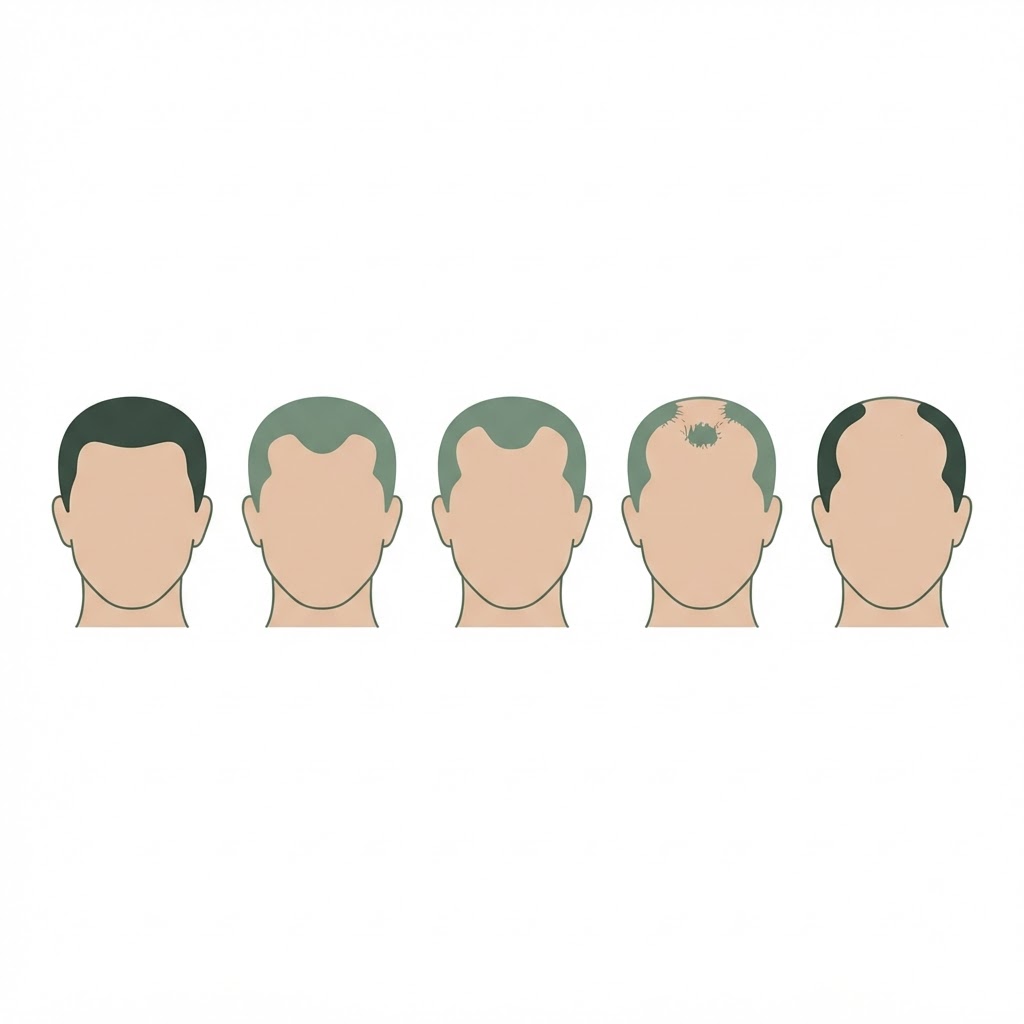
Progressive stages of male pattern hair loss

Male Pattern Baldness or Male Androgenetic Alopecia is the most common cause of hair loss in men. It follows a pattern, normally beginning at the temples, the crown, or both and gradually growing, until the top of the head is devoid of hair meanwhile the back and sides of the scalp are usually left.


This distinctive distribution earns it the name Male 'Pattern' Baldness.


The Role Of Genetics

Androgenetic Alopecia is strongly hereditary, hence why not all men suffer. It can be inherited from either parent, or in my case both! A history of balding in your family is a well known indicator that you may suffer, however a lack of history of it in your family doesn't guarantee you are exempt.


Hormones and hair loss

The key driver of MPB is a hormone called DHT (dihydrotestosterone). DHT is an androgen, converted from testosterone by an enzyme called 5 Alpha Reductase (5AR).
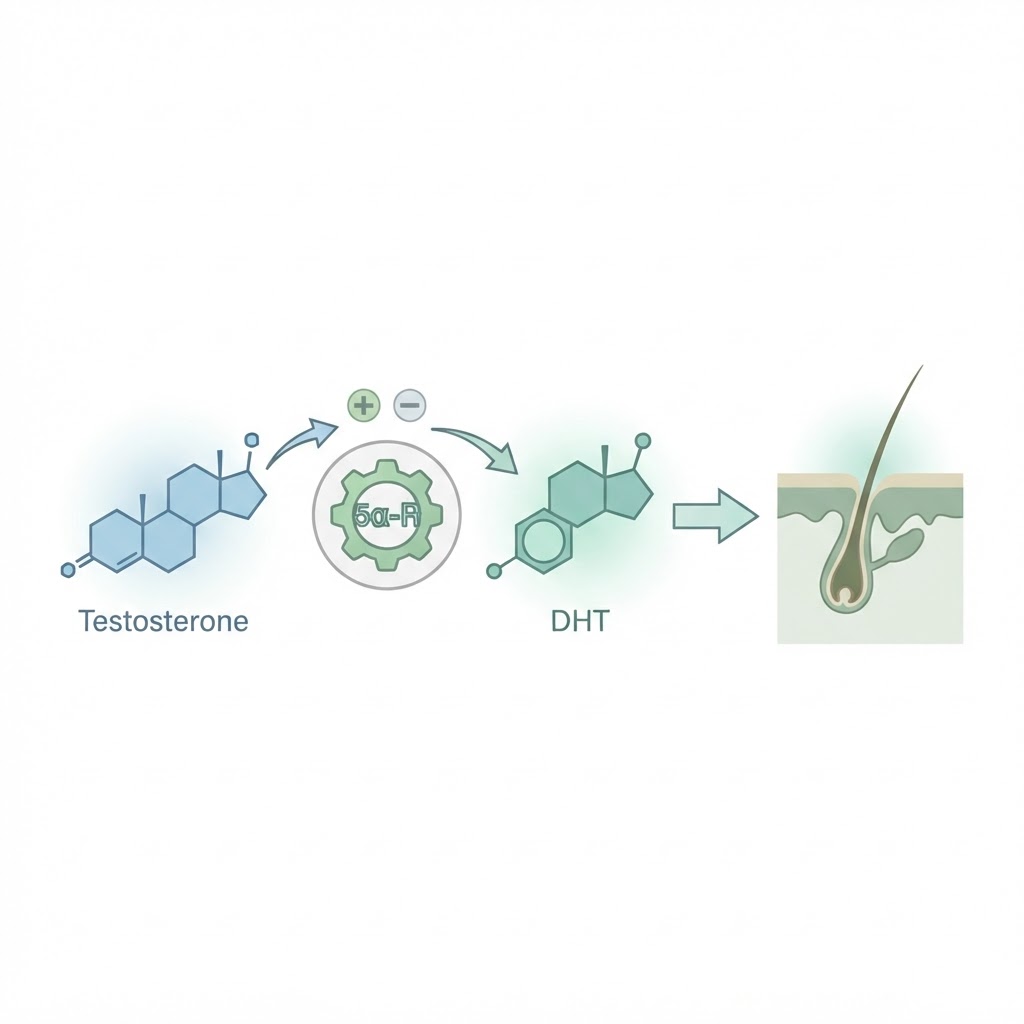
How testosterone is converted to DHT

In people with susceptible follicles, DHT binds to receptors in the hair follicle cells and shortens the growth phase of your hair follicle, over time this compounds until eventually the follicle stops producing visible hair at all. Follicles at the sides and back of the head carry less receptors to DHT which is why they don't suffer as much.


The goal of many prescription medicines is to reduce the presence of DHT in the bloodstream, as a result reducing the levels that reach the hair follicles and stopping this cycle of hair follicle shortening. For more information on hair growth cycles please read my article on that.


If you are not losing hair in this pattern, or are unsure of the driving cause of your hair loss, you must seek help from a professional. If there is something underlying causing your hair loss, it may need investigation.


I hope this helps clear up any questions you have, and if you want more information please dont be afraid to email me.


Ed at HairLume

It can be troubling once you realise you are truly balding. It is a difficult thing, to go from once having hair, to not. Many options are available, but few have been studied and proven, this is my summary of what the published evidence reports.

Common hair loss medications

Treatment for hair loss is backed scientifically by 3 main methods, however this article contains information around just 2 of those.


Finasteride

Finasteride is a prescription-only medicine, taken daily, that reduces DHT. It must be prescribed by a clinician who can assess whether it is appropriate for you. It acts by inhibiting the presence of 5 alpha reductase. This in turn prevents testosterone from converting to DHT. Less DHT in the bloodstream means less DHT at the hair follicle.


Topical Minoxidil

Minoxidil is a liquid or foam, applied to the scalp. It also appears as pills however this is an off-label prescription, meaning it is not being prescribed for it's officially approved use. A randomised trial found that 5% minoxidil caused hair growth in men more than 2% and placebo.

Medicated anti-dandruff shampoo

Setting expectations

Reported changes in studies typically take many weeks to months to appear, and the described aim is usually to slow further loss and improve the appearance of density. Stopping a measure generally means any reported benefit is lost. Where reported regrowth is not enough, hair transplantation is an option that may be considered by suitable candidates, usually after other measures.


When to seek professional advice promptly

See a clinician without delay if hair loss is sudden or patchy, or is accompanied by itching, burning, scaling, redness, feeling unwell, weight loss, or (in women) menstrual changes. These can point to causes other than simple pattern loss that need their own assessment.


In summary

•Confirm the cause before acting — don't self-diagnose.

•Options with the most published evidence in men include topical minoxidil and a prescription-only medicine that a clinician may assess for suitability.

•Low-level laser devices and cosmetic scalp-care may be used as supporting measures.

•Reported effects take months, and consistency appears to matter.

•Always consult your GP, prescribing clinician, or pharmacist before starting, changing, or stopping anything.


Ed at HairLume


Finasteride Side Effects (Reported in <2% of users in clinical trials):

•Decreased libido

•Erectile dysfunction

•Ejaculatory dysfunction


Most side effects resolved whilst continuing therapy or shortly after discontinuation in clinical trials. Many users report no side effects at all.


Minoxidil Side Effects:

•Scalp irritation or dryness

•Initial shedding (first 2–4 weeks, a telogen effluvium response)

•Unwanted facial hair growth (if applied carelessly)


What to Monitor:

Track your mood, energy, and libido weekly. If you notice persistent changes lasting more than 2 weeks, consult your prescribing clinician.


Important: Never adjust dosages without medical guidance.

Nutrient-rich foods supporting hair health

1. Consistency is Everything

Missing doses reduces effectiveness significantly. Aim for the highest possible adherence — even brief gaps matter with treatments like finasteride.


2. Nutrition Matters

•Iron, zinc, biotin, and vitamin D deficiencies are associated with hair loss — supplementing only if deficient is recommended

•Adequate dietary protein supports hair structure

•Note: over-supplementation of selenium, vitamin A, and vitamin E has been linked to hair loss


3. Scalp Health

•Use ketoconazole shampoo 2–3x/week — it has demonstrated effects on hair density and anti-androgenic activity

•Standardised scalp massage (9–11 min daily) has been shown to increase hair thickness by mechanically stimulating dermal papilla cells

•Avoid harsh chemicals and excessive heat styling


4. Lifestyle Factors

•Psychological stress is associated with hair loss conditions including telogen effluvium

•Prioritise quality sleep (7–9 hours)

•Regular moderate exercise is generally beneficial

Common hair loss medications

Finasteride (Propecia/generic)

•Inhibits type II 5-alpha reductase, reducing scalp DHT by approximately 60–70%

•FDA-approved for male androgenetic alopecia

•Takes 3–6 months for visible results; continued daily use required to maintain benefit

•Discontinuation leads to reversal of benefit within 12 months


Minoxidil

•FDA-approved topical treatment (5% solution/foam for men; 2% for women)

•Prolongs the anagen (growth) phase and increases follicular size

•Apply to dry scalp twice daily; results typically visible at 3–4 months

•Available as topical or low-dose oral (off-label)


Dutasteride (off-label/emerging)

•Inhibits both type I and type II 5-alpha reductase, reducing DHT more completely than finasteride

•Evidence suggests superior efficacy to finasteride for AGA

•Adverse event profile similar to finasteride in comparative trials

Morning:

1. Apply minoxidil to dry scalp

2. Take finasteride with breakfast

3. Take daily supplements (Biotin, Vitamin D)


Evening:

1. Wash hair with caffeine shampoo (on shampoo days)

2. Apply minoxidil before bed (wait 4+ hours after morning application)

3. 5-minute scalp massage


Weekly:

•Take progress photos (same angle, lighting)

•Log side effects in the app


Monthly:

•Compare photos

•Review AI Hair Score trends

•Adjust routine if needed

What is Post-Finasteride Syndrome (PFS)?

PFS is a recognised but incompletely understood condition in which a cluster of symptoms — including persistent sexual dysfunction, cognitive difficulties, and mood changes — continue or emerge after stopping finasteride. It is documented in peer-reviewed literature and taken seriously by researchers, though causality and prevalence remain areas of active study.


What symptoms are reported?

Published studies describe three main domains:

•Sexual: low libido, erectile dysfunction, reduced genital sensitivity, ejaculatory changes

•Cognitive: difficulty concentrating, mental fog, memory complaints

•Psychological: depression, anxiety, emotional blunting


How common is it?

Precisely quantifying prevalence is difficult — most large clinical trials were not designed to capture persistent post-discontinuation effects. Observational data and case series suggest the condition is rare, but it is not negligible. The 2022 literature review (PMID 35983808) notes that sexual and systemic adverse effects can persist after stopping the drug in a subset of users.


The neurobiological angle

A leading hypothesis is that finasteride disrupts the synthesis of neuroactive steroids — particularly allopregnanolone (a GABA-modulating neurosteroid derived from progesterone). A 2013 CSF and plasma study (PMID 23890183) found measurably reduced neuroactive steroid levels in men on finasteride who reported depressive symptoms. This may help explain mood and cognitive effects beyond simple DHT suppression.


If you're concerned, here's what to do:

•Track your mood, energy, and libido weekly in the app

•If something feels off, speak to a doctor promptly — not online forums

•A full hormonal panel (testosterone, DHT, SHBG, oestrogen, prolactin, thyroid) can help rule out other causes

•Consider discussion with a neurologist or endocrinologist if symptoms persist after stopping


The bottom line

PFS is real, documented in the literature, and should not be dismissed. At the same time, the majority of men who use finasteride, do so without persistent adverse effects. The prudent approach is to go in fully informed, monitor yourself consistently, and maintain open communication with your prescribing clinician. If symptoms occur, discontinuation and prompt medical review are the appropriate steps.